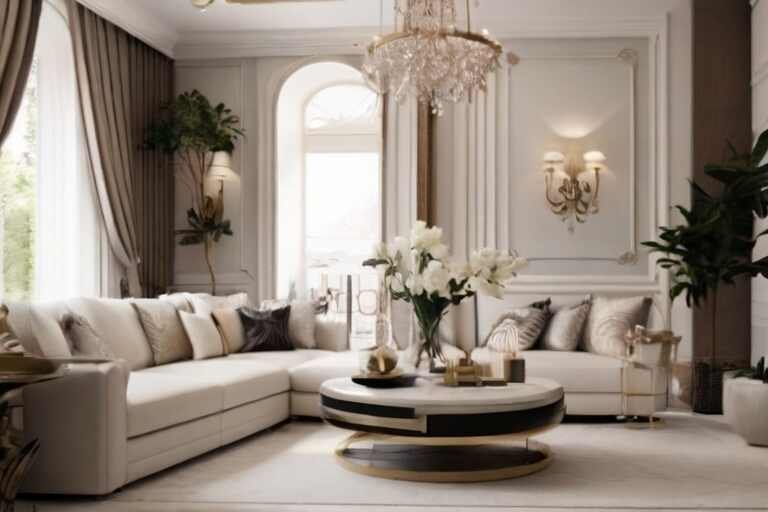
I’ve been inside a lot of living rooms. Some had cost a great deal of money and felt cold. Some were modest, almost spare, and felt like exactly the kind of place you’d want to stay for hours. The difference was rarely furniture — it was something harder to name. Whether the room had been thought about, rather than assembled.
After six years working on other people’s rooms, here’s what I actually believe about living room décor.
The sofa is the room
Everything in a living room negotiates with the sofa. The rug, the coffee table, the lighting, the art on the wall — they all take their cue from that one central piece. Which means getting the sofa wrong is expensive, not just financially but in terms of the energy you’ll spend trying to work around it.
What I look for: proportion first. A sofa that’s too small for the room floats awkwardly; one that’s too large closes the space down. Colour matters less than you think — a neutral ground gives you the most flexibility as everything else in the room evolves. And depth matters more than most people realise. A deep seat, something you actually sink into, changes how the room is used. It becomes a place where people stay, rather than perch.
The rug anchors everything
The most common rug mistake I’ve seen — and I’ve seen it in expensive rooms as well as budget ones — is a rug that’s too small. A rug that only fits under the coffee table, with the front legs of sofas floating beyond its edge, makes the whole seating arrangement feel unmoored. The rug should be large enough that all the key pieces either sit fully on it or have at least their front legs on it.
A rug defines the zone. It says: this is the conversation area, this is where the room lives. Get the size right and the rest of the room organises itself around it. Get it wrong and no amount of styling will make the space feel settled.
Warm light changes everything
I’ve never walked into a living room that was too warm and too well-lit and thought: this doesn’t work. I’ve walked into many that were over-bright, under-layered in their light sources, and felt exhausting as a result. The ceiling overhead light, on its own, is rarely the answer for a living room. It’s a utility light — good for finding your keys, not for spending an evening in.
Layer your light. A floor lamp in the corner. A table lamp at reading height beside the sofa. Candles, if that suits you. The goal is multiple sources at different heights, all warm in tone. When you turn the overhead off and the lamps on, the room should feel like it exhales. That shift — overhead off, lamps on — is one of the simplest and most powerful decorating moves there is.
Bring the outside in, selectively
Natural materials — wood, linen, stone, woven rattan — do something in a living room that synthetic materials almost never manage: they age gracefully, they add texture without noise, and they make a room feel less like a set and more like a place where people actually live.
A wooden side table with a few visible grain lines. A linen throw over the arm of the sofa. A ceramic bowl on the coffee table, handmade rather than factory-perfect. These things bring quiet life into a room. They signal that the person who lives there values substance over surface — and that comes across to anyone who sits in the space.
Personal objects over shop-bought styling
One of the things I noticed in professionally styled show homes — rooms that photographed beautifully and felt oddly empty in person — was the absence of anything personal. No book with a cracked spine. No object that required explanation. No evidence that an actual human being lived there.
The rooms I remember most were not the cleanest or the most composed. They were the ones where something on the shelf made me ask a question. A piece of pottery from a particular market. A photograph propped against a stack of books. A plant that had clearly been there for years and had grown to fill its corner. These things can’t be bought as a set. They accumulate — which means the most meaningful living rooms are always works in progress, not finished products.
Edit before you add
The instinct when a room feels wrong is to add something. A new cushion, another plant, a different throw. But in most cases, what the room needs is the opposite. Take things away first. Clear the coffee table completely, then put back only what you’d genuinely miss. Move the side table to a different wall and see whether the room breathes. Take one of the five cushions off the sofa.
Subtracting is harder than adding — it asks you to make a decision rather than defer one. But a room with fewer, better things will almost always outperform a room that’s trying to do everything at once. The most elegant living rooms I’ve been in have felt restrained. Not empty — restrained. There’s a difference, and learning to feel it is the whole of interior decoration.
