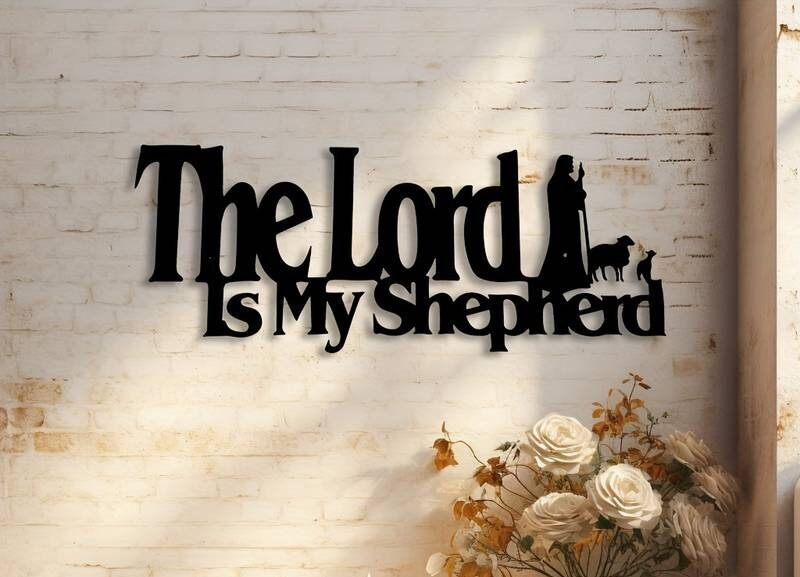
I’ve worked in homes of every kind — secular, spiritual, minimalist, maximalist — and the ones that communicated faith most powerfully were rarely the ones with the most religious objects in them. The homes that felt genuinely rooted in Christian faith tended to have a quality of peace and intentionality that went beyond what was hanging on the walls. The decor expressed something real; it wasn’t performing belief, it was living it.
That distinction matters. There’s a difference between a home decorated with Christian objects and a Christian home. The first is a style choice; the second is a way of inhabiting a space. Here’s what I’ve observed, working in and around other people’s homes for six years, about how faith shows up in a room when it’s done with care.
Restraint is not a lack of faith
The first instinct when decorating a Christian home is often to fill it — a Bible verse on every wall, a cross in every room, scripture on the cushions and the candles and the kitchen prints. I understand the impulse. But the homes that made the deepest impression on me were the ones where the faith objects were chosen and placed with the same care you’d give to anything else. One cross, well-placed, speaks more clearly than five.
Restraint isn’t a sign of diluted faith. It’s what gives each object room to mean something. When everything on every surface is saying the same thing at the same volume, the eye stops landing anywhere, and the message gets lost in the noise. Choose what matters most to you — a single verse, a significant symbol, a devotional corner — and give it space to be seen.
The cross as a design object
The cross is the central symbol of Christian faith, and it’s also one of the most versatile objects you can put in a room. A simple wooden cross — natural grain, no finish — on a white wall above a console table is quiet and profound. A hand-forged iron cross on a brick chimney breast has weight and permanence. A small silver cross on a bedroom shelf is intimate.
What I’d avoid is the mass-produced cross with decorative flourishes added purely to fill retail shelf space — the ones that look the same in every Christian gifts shop. The symbol has enough power on its own; it doesn’t need embellishment. When you find a cross made with real craft — by an artisan who thought about the material, the proportion, the finish — you’ll know it. That’s the one worth displaying.
Choosing scripture with honesty
Scripture on walls is one of the most common forms of Christian home decor, and one of the easiest to do thoughtlessly. The verse everyone uses, rendered in the same cursive script, printed on the same bleached wood board — it becomes wallpaper. Your eye moves past it because it asks nothing of you.
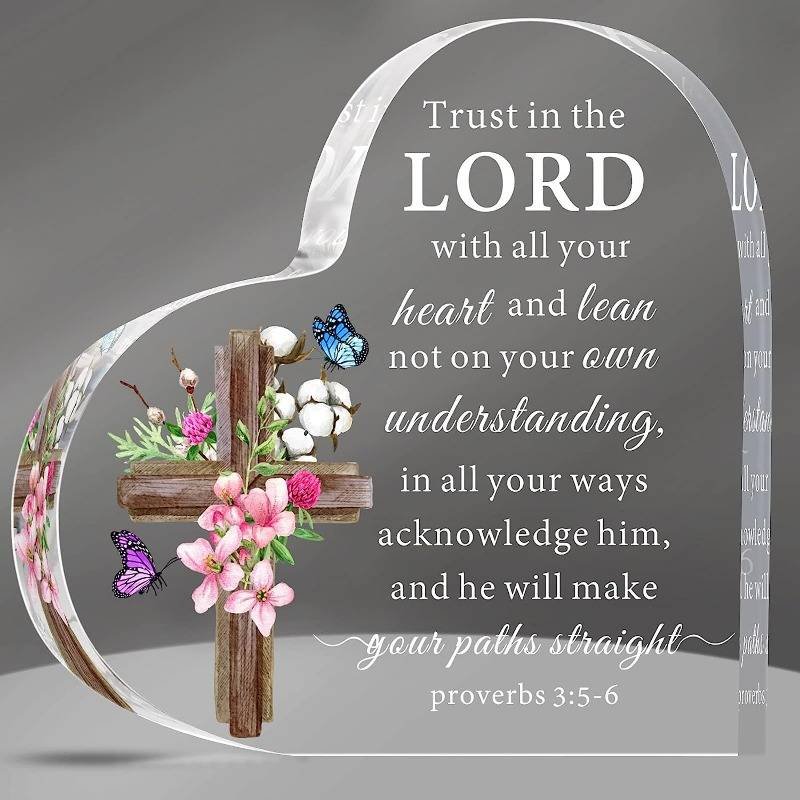
The verse that works in a room is the one that has actually meant something to you — a passage you returned to in a difficult year, a promise that held when other things didn’t. It doesn’t have to be the most visually obvious choice. It just has to be true. When a guest reads it and asks about it, and you have a real answer, that’s when the object is doing what it’s supposed to do.
Christian symbols — used with understanding
Beyond the cross, the Christian visual tradition is rich: the ichthys, the dove, the chi-rho, the alpha and omega, the crown of thorns, the anchor. Each carries specific theological meaning. When you display these symbols, the most powerful version is when you know what they mean and chose them for that reason — not because they were available on a tea towel at a church gift shop.
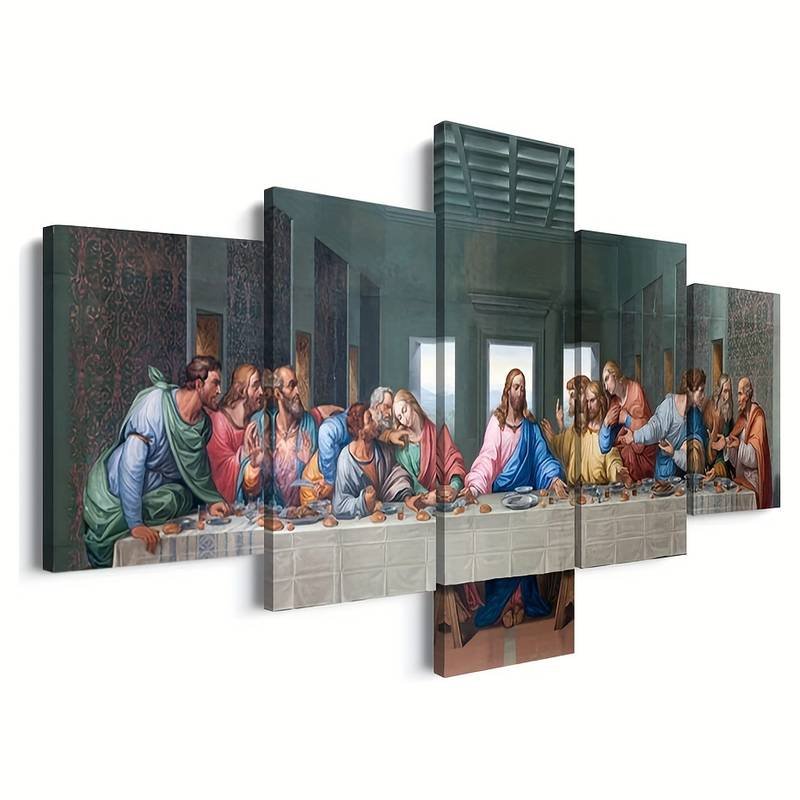
Religious art — a painted icon, a reproduction of a great biblical scene, a carved wood relief — can carry centuries of devotional tradition into a contemporary room. These pieces work well when they’re given proper space: hung at the right height, with breathing room, in a place where someone will actually stop and look. Not lost between a houseplant and a light switch.
A prayer corner done properly
Of all the devotional spaces I’ve seen in homes, the ones that were actually used shared a few qualities: they were quiet (away from the main traffic of the house), they were visually simple (a single chair or kneeler, a small table, a candle, a Bible), and they were lit well (natural light where possible, warm lamp light otherwise).
The ones that weren’t used were usually too elaborate — trying to be a chapel rather than a corner. A prayer space doesn’t need to announce itself. It needs to make it easy to sit, be still, and be present. A comfortable chair by a window with good morning light, a small surface for a Bible and a candle, a framed verse or a cross on the wall — that’s enough. More than that, and it starts to feel like a display rather than a place.
Light and natural materials as an expression of faith
One of the things I noticed in homes where faith felt genuinely woven into the fabric of the space — not just displayed but lived — was an attention to the quality of light and material. Warm lamplight rather than harsh overhead fluorescent. Wood and linen and stone rather than plastic and synthetic. Candles lit in the evening.
There’s a tradition in Christian theology of seeing beauty as pointing toward God — the created world as a reflection of the Creator. When a home is decorated with that sensibility, it communicates something beyond any individual object. The care taken with light, with material, with proportion — it signals that this is a place where someone has paid attention, and that attention is itself an act of reverence.
Books that have been read
The most quietly powerful Christian homes I’ve been in always had books — not decorative, spine-outward books arranged by colour, but real ones with cracked spines and dog-eared pages and occasional notes in the margins. A well-worn Bible on the coffee table says something that a pristine display Bible doesn’t. Devotional books, theological reading, lives of the saints — when these are evidently used rather than displayed, they tell a guest something true about who lives in the house.
This is harder to manufacture than hanging a print. It takes years. But it’s one of the most honest things a Christian home can communicate — that the faith is practised and thought about, not just signalled.
What the home says to guests
Every home communicates something to the people who walk into it. A Christian home, at its best, communicates welcome, peace, and an orientation toward something beyond the material world. That quality doesn’t come from the right products; it comes from the way a space is tended and inhabited over time.
The objects matter — a cross chosen with care, a verse that has personal meaning, a prayer corner that gets used, books that show evidence of reading. But what they’re pointing toward matters more. Decorate toward that, and the room will reflect it.
